

 The Department of Artificial Intelligence and Machine Learning (CSE-ALML) at Takshshila Institute of Engineering & Technology, Jabalpur, offers a cutting-edge undergraduate program focused on the most dynamic areas of modern computing. The B.Tech. in CSE-AIML is designed to develop next-generation engineers who can build intelligent systems, develop machine learning models, and solve real-world problems using data-driven approaches.
With CSE-AIML revolutionizing industries such as healthcare, finance, robotics, agriculture, and smart cities, this program empowers students to gain expertise in deep learning, computer vision, and natural language processing (NLP), reinforcement learning, and AI ethics.
Students are equipped with strong fundamentals in mathematics, programming, data analysis, and AI frameworks, enabling them to innovate and lead in the age of intelligent automation and smart systems.
Program Educational Objectives (PEO)
The PEO of the B.Tech. CSE-AIML program aims to:
- Build Strong Foundations – Equip students with a solid base in mathematics, programming, statistics, and data structures.
- Develop AIML Expertise – Train students in machine learning algorithms, deep learning, NLP, and AI system development.
- Encourage Innovation – Promote critical thinking, creativity, and research in solving real-world problems using AIML technologies.
Prepare for Industry 4.0 – Align curriculum with modern tools and industry needs like TensorFlow, PyTorch, cloud AI, and automation. - Foster Ethical AI – Instill awareness of ethical issues in AI, including fairness, privacy, and responsible data use.
.
Head of Department – Prof. Shobhit Verma

The Department of Computer Science and Engineering at Takshshila Institute of Engineering & Technology, Jabalpur, is headed by Dr. Shobhit Verma, a distinguished academician with 19 years of teaching experience. He is a Ph.D holder and has a prominent record in M.Tech ,B.E with a vast research experience , making him a highly qualified leader in the domain of computing and technology.
Prof. Verma specializes in Artificial Intelligence, Machine Learning, Data Science, Cloud Computing, and Cybersecurity. Under his leadership, the department has witnessed significant advancements in curriculum development, research collaborations, and industry partnerships. His vision is to equip students with practical knowledge, technical skills, and an innovative mindset, ensuring they excel in software development, AI research, and emerging technologies.
He has mentored numerous research projects, technical workshops, and industry-driven initiatives, preparing students for high-demand careers in IT, software development, and digital transformation. His expertise in cutting-edge technologies like deep learning, blockchain, and DevOps has been instrumental in aligning the department’s academic framework with modern industry requirements.
With a strong commitment to quality education, skill-based learning, and holistic student development, Prof. Verma ensures that graduates from the department emerge as technically proficient, industry-ready, and future-oriented professionals.
Course Snapshot
- Duration: 4 Years (8 Semesters)
- Eligibility: 10+2 with PCM (Physics, Chemistry, Mathematics)
- Degree Awarded: B.Tech. in CSE-Artificial Intelligence and Machine Learning
- Key Focus Areas:
- Machine Learning & Deep Learning
- Python & R Programming
- Data Science & Data Analytics
- Natural Language Processing (NLP)
- Computer Vision
- Cloud AI and Edge computing
- Ai in IOT and Robotics
Course Content
The curriculum integrates foundational subjects with advanced AI/ML modules:
- Core Subjects: Programming in Python, Linear Algebra, Probability & Statistics, Data Structures & Algorithms
- AIML Modules: Supervised & Unsupervised Learning, Neural Networks, Deep Learning, Reinforcement Learning
- Specializations: NLP, Computer Vision, Recommendation Systems, AI in Healthcare, Smart Systems
- Tools & Frameworks: TensorFlow, PyTorch, Scikit-Learn, Keras, OpenCV, NLTK
- Project Work: Real-time projects, case studies, AI product development, and internships.
Facilities
- AIML Lab: Equipped with high-performance GPUs, deep learning workstations, and cloud access.
- Smart Classroom: Tech-enabled classrooms for hybrid learning and virtual AI labs.
- Research & Innovation Hub: Space for students to work on AI prototypes, participate in hackathons, and publish research.
- Industry Collaborations: MoUs with AI companies for internships, workshops, and placement support
Career Options
Graduates of B.Tech in CSE-AIML have diverse and lucrative career opportunities:
- Machine Learning Engineer
- Data Scientist / Analyst
- AI Researcher
- NLP / Computer Vision Engineer
- Robotics / Automation Specialist
- AI Software Developer
- Cloud AI Engineer
They can work in sectors such as healthcare, fintech, cybersecurity, smart cities, e-commerce, autonomous vehicles, and more.
Faculty
Our faculty consists of experienced academicians, data scientists, and AI practitioners from reputed institutions, with expertise in:
- Artificial Intelligence
- Machine Learning
- Data Analytics
- Deep Learning
- Cloud & Edge AI
- Robotics & Automation
Activity
The department organizes regular:
- AI Workshops and Bootcamps
- Coding and ML Hackathons
- Guest Lectures from Industry Experts
- AI Research Paper Presentations
- Student-led AI Clubs and Competitions
- National and International Conference Participation
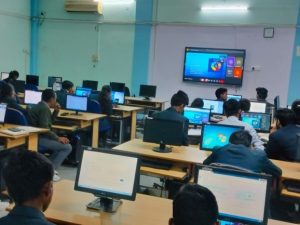 The Department of CSE-AIML of Takshshila Institute of Engineering and Technology organized a 15-day online training program on Artificial Intelligence and Machine Learning (AI/ML) in collaboration with IBM to enhance students’ technical knowledge and industry-oriented skills. The training provided in-depth exposure to fundamental and advanced concepts of AI and ML, along with practical insights into real-world applications and tools used in the industry. Through expert-led sessions and hands-on learning, students gained valuable understanding of emerging technologies, strengthening their analytical and problem-solving abilities and preparing them for future academic and professional challenges in the field of intelligent systems.